








There is an entire corner of the chicken world devoted to building the perfect rainbow egg basket. Blue eggs, green eggs, olive eggs, chocolate brown eggs, speckled eggs, and whatever we're calling those suspiciously pink ones this week. People will choose six or eight different breeds just to get that basket, and honestly, I get it. A pile of different colored eggs is ridiculously pretty.
But apparently I have a different problem.
I want the rainbow wandering around my yard.
One of my favorite things about raising landrace chickens is that I can walk into a breeding pen filled with one breed and still have a whole lot of visual variety looking back at me. Depending on the landrace, I can have different plumage colors and patterns, different combs, crested and non-crested birds, and chicks that don't all grow up looking like copies of their parents.
They're still the same landrace. They still belong to the same population. They just don't have to match.
And if you're somebody who loves a colorful, interesting flock but doesn't necessarily want to collect a dozen different breeds to get one, that is pretty damn cool.


Swedish Flower Hens Are Basically Cheating
If the goal is to build a colorful flock while keeping one breed, Swedish Flower Hens make this almost ridiculously easy.
The “flowered” part of their name comes from the white tips on their feathers, which create that scattered flower effect across the bird. But underneath those flowers can be different base colors and patterns, which means a flock of Swedish Flowers doesn't have to look like somebody hit copy and paste twenty times.
You can have birds leaning toward reds and golds, darker birds, blues, and different combinations within the population. Some birds are crested and some aren't. Even within the same breeding flock, there can be enough variation that you find yourself watching chicks grow just to see what the hell they're going to look like.
That's one of the reasons I love hatching them. You know you're hatching Swedish Flower Hens, but that doesn't mean you know exactly what every adult bird is going to look like when you pull that chick out of the incubator.
And before somebody takes that as permission to breed exclusively for the coolest-looking chicken in the pen, no. 😂 The body underneath those feathers still matters. We're preserving a landrace, not running a feather-color contest. But we're absolutely allowed to enjoy the hell out of the variety that comes with it.

Icelandics Apparently Never Got the Matching-Flock Memo
Icelandics take the idea of variation and run with it.
Within the population, you can see a broad range of plumage colors and patterns along with different comb types, and some birds may be crested. Put a group of Icelandics together and you can get the kind of visually interesting flock people sometimes try to create by buying a completely different breed for every chicken in the yard.
Except they're all Icelandics.
That's what I find so fascinating about them. The variation isn't something we've created by crossing a bunch of breeds together for fun. It's part of a landrace population with a very long history behind it.
And because we're maintaining the population rather than trying to turn Icelandics into one specific-looking chicken, the goal isn't to decide which color is the prettiest and make the entire flock look like that. The variation gets to stay.
For someone who gets bored easily, this is an excellent chicken feature. 😂

Hedemoras Bring a Completely Different Kind of Variety
Hedemoras are a good reminder that “colorful flock” doesn't have to mean every chicken looks like somebody spilled a paint box.
There's visible variation within Hedemoras, but some of what makes them interesting is texture and feather type. They are known for unusually dense plumage and under-down, which makes sense considering where they developed in northern Sweden, and the population also includes the woolly feather type.
That means two Hedemoras can both very obviously belong in the same flock without being carbon copies of one another. Different plumage colors and feather characteristics give you plenty to look at while the important characteristics of the population are still there underneath all that fluff.
And yes, the woolly ones are ridiculously cute.
I am a preservation breeder, not a robot. I'm allowed to say it. 😂

Shetlands Like to Keep Things Interesting Too
Our Shetlands give us another version of variety because we can have tappit and non-tappit birds along with different plumage colors and patterns. A tappit is the little crest you see on some Shetlands, and it can completely change the appearance of a bird even when she's standing beside another hen from the same population.
Shetlands are particularly interesting because we have less historical preservation documentation for them than we do for the Swedish landraces, which means I'm careful about making sweeping claims about what every Shetland should look like. We know variation exists within the population, but that doesn't mean I'm interested in pushing them toward increasingly dramatic crests or selecting every unusual trait simply because it's different.
And because apparently Shetlands refuse to cooperate fully with an article about ignoring egg color, they also give us blue to blue-green eggs along with the occasional brown or white egg. I currently have a Shetland hen laying a white egg because chickens enjoy making sure none of my explanations are ever too tidy.
So yes, you can build a colorful Shetland flock.
Your egg basket may decide to participate anyway.

Ölandsk Dwarfs Prove Variation Still Has Boundaries
Ölandsk Dwarfs are one of my favorite examples of why landrace variation does not mean anything goes.
They're tiny chickens. That small body size is part of what we're supposed to preserve, so I don't care how spectacular a larger bird's feather pattern might be. I'm not going to start selecting bigger Ölandsk Dwarfs because I think they're prettier or easier to sell.
Within those boundaries, though, there's still visual variation to enjoy. Their characteristic plumage includes combinations of brown or wild-type tones, black, and white, with the white-tipped flowering that gives individual birds plenty of personality without turning the population into a free-for-all.
That's really the balance with landraces. We aren't trying to make every bird identical, but we aren't trying to create maximum visible difference either. We're maintaining the population and enjoying the variation that's supposed to be there.
And in the case of Ölandsk Dwarfs, we're doing it in an absurdly small package with an unreasonable amount of chicken crammed inside.
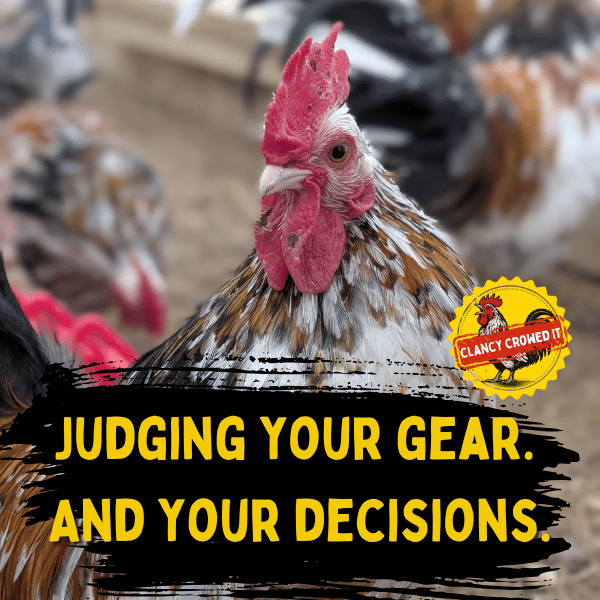
Clancy has entered the chat.

And Then There Are Swedish Blacks
Swedish Black Hens are the chicken I want standing in the corner of this article ruining everybody's assumptions. 😂
Because if I say landraces can give you colorful, variable flocks and leave it there, it's really easy to walk away thinking that broad visible variation is some kind of requirement for being a landrace.
It isn't.
Swedish Blacks have a much more consistent overall appearance. Their fibromelanistic pigmentation gives them the dark feathers, skin, comb, wattles, and other dark tissues they're known for. There can still be variation among individual birds because they're living animals, not factory parts, but you're not going to hatch the same rainbow of plumage you'd expect from something like Icelandics or Swedish Flower Hens.
They're still a landrace.
That's important because visible variety and genetic diversity are not the same thing. I can't stand at the gate, count feather colors, and determine how genetically diverse a flock is. The colors are simply one of the parts we get to enjoy in the populations where that visible variation belongs.

You Don’t Need a Chicken From Every Aisle
There's nothing wrong with having a mixed flock. Plenty of people love having one chicken from this breed, two from that one, another because she lays blue eggs, and one they bought entirely because she was cute at the feed store and apparently nobody in that family has impulse control.
I understand this deeply. 😂
But keeping multiple breeds also means keeping chickens that may have very different characteristics. They can differ in size, temperament, broodiness, flightiness, climate tolerance, production, and management needs. That isn't necessarily a problem, but it's something people don't always think about while they're building the world's prettiest assortment of chicks.
A visually diverse landrace flock gives you another option. You can choose a population whose general characteristics fit what you want from your chickens and still have plenty of individual variation to enjoy. Instead of creating variety by collecting completely different breeds, you're seeing variety expressed within one population.
And if you decide you want to breed them, you're already working within one landrace rather than trying to figure out which of your twelve roosters just fathered a chick that appears to have been assembled from spare parts.
Not that such a chick wouldn't be adorable.
We're just doing something different here.
Pretty Is Allowed. It Just Doesn’t Get to Drive the Bus.
We talk a lot about preserving body type, health, production, reproductive ability, and the functional characteristics of these landraces, and I don't want that message to accidentally become “you're not supposed to care what your chickens look like.”
Have you seen our chickens?
Of course I care what they look like. 😂 I have eyes. A gorgeous Swedish Flower Hen walking across the yard can still stop me in the middle of whatever I'm doing. Watching Icelandic chicks feather out is fun precisely because I don't know exactly what I'm going to get. A woolly Hedemora is objectively difficult not to stare at, and Clancy has built an entire public persona around being approximately twelve ounces of feathered audacity.
The difference comes when we're making breeding decisions. I don't want to narrow an entire population because one color suddenly becomes popular, exaggerate a crest because customers think it's cute, or move away from the appropriate body type because another version photographs better. Pretty gets to be part of the chicken. It just doesn't get to make every decision about the chicken.
That's how you enjoy visible diversity without accidentally breeding it out in pursuit of your favorite version of it.
The Rainbow Can Walk Around the Yard
I still understand the rainbow egg obsession. Opening a nest box and finding blue, green, cream, brown, and speckled eggs together is fun, and I'm certainly not going to complain when one of our Shetlands leaves me a gorgeous blue-green egg.
But the egg isn't the only place chickens can give you color.
Sometimes the rainbow is scratching through the grass. Sometimes it's twenty Swedish Flower chicks growing into colors you couldn't completely predict when they hatched. Sometimes it's a flock of Icelandics where the birds clearly belong together without looking like somebody ordered the exact same chicken twenty times.
That's one of the things I love most about landraces with visible variation. I don't have to choose between maintaining one population and having a flock that's interesting as hell to look at.
I can have both.
And unlike the egg, this rainbow occasionally jumps the fence, steals my snacks, digs holes where I specifically asked it not to, and screams at me from the other side of the yard because apparently I've committed some kind of personal betrayal.
Honestly, I'll take the chickens.
🐔
One flock, many shades
Different feathers, shared roots
The rainbow has legs


